Price options, simulate markets and measure risk in Python — the math that runs
trading desks, taught from the intuition up. No finance background required.
Secure checkout via Hotmart · 14-day money-back guarantee
0
Students
0
Countries
0★★★★★
Average rating
0
Weeks + capstone
§1 What you build
Four things you'll be able to do
Not concepts you've heard of. Code you wrote and can explain.
01
Price an option
Your own Black-Scholes calculator in Python, and Delta, Gamma, Vega and Theta read the way a desk reads them.
02
Simulate a market
Model prices with Brownian motion and run 10,000 Monte Carlo paths to value what has no closed formula.
03
Measure real risk
VaR, Sharpe, Sortino, max drawdown — computed, backtested and interpreted, not quoted from a textbook.
04
Ship a portfolio piece
A capstone pricing engine or backtest you can put on GitHub and talk through line by line in an interview.
§2 Week 4, running in your browser
This is the kind of thing you'll write
A geometric Brownian motion simulator: 40 possible futures for a $100 asset over one year.
Move the volatility, hit run. By week four you'll have written this yourself — and you'll know
why each line is there.
S(t) = S₀ · exp[(μ − σ²/2)t + σW(t)]
Median
—
Best path
—
Worst path
—
P(loss)
—
40 paths · μ = 8% · 252 trading days. Illustration of a stochastic process, not a forecast
of anything and not investment advice.
§3 Week 5, running in your browser
How bad is a bad day?
20,000 simulated daily returns on a portfolio. VaR
is the loss you don't expect to exceed — 95 days out of 100. CVaR
is the average of the other five. Switch to 99% and watch them separate: that gap is the
whole reason risk desks report both.
Loss distribution · daily horizon
VaR 95
—
VaR in dollars
—
CVaR 95
—
CVaR in dollars
—
σ = 22% annualised, normal returns, 1-day horizon. A teaching model: real return
distributions have fatter tails, which is exactly why CVaR earns its keep. Illustration,
not a forecast and not investment advice.
§4 Curriculum
Six weeks, one build per week
Every week has a goal, the material, and something you produce. Six weeks is the recommended pace, not a deadline — the material is yours for good.
01Setup & what a quant actually does
Goal: get your lab running and understand the job before the math.
›Python, Anaconda and virtual environments — a professional setup from scratch.
›The math refresher you actually need: algebra, calculus, applied statistics.
›The roles: trading, risk, structuring, research — and what firms look for in each.
Outcome: a working environment and a clear map of where you're heading.
02Probability & stochastic processes
Goal: model price and uncertainty the way the models really do it.
›Brownian and geometric Brownian motion: putting randomness into prices.
›The intuition behind Black-Scholes — the idea before the formula.
›Simulating price paths in Python.
›Reading the output: what variability does and doesn't tell you.
Outcome: you can simulate market scenarios and reason about uncertainty.
03Option pricing & the Greeks
Goal: compute option prices and their sensitivities yourself.
›Black-Scholes from the ground up.
›Your own option calculator, written in Python.
›Delta, Gamma and Vega: what each one is really measuring.
›Mini lab: delta-hedging a position and watching it behave.
Outcome: your own pricing tools plus a simulated hedge.
04Monte Carlo simulation
Goal: value assets and options when there's no closed-form answer.
›Multi-path price simulation at scale — the engine behind §2 above.
›Monte Carlo valuation of assets and derivatives.
›Error and convergence: how many paths is enough.
›Lab: a simulator of 10,000 possible futures.
Outcome: realistic simulations and prices computed numerically.
05Risk management
Goal: measure and control risk with the metrics desks actually report.
›Value at Risk (VaR) from first principles — the calculator in §3 above.
›Backtesting: Sharpe, Sortino and maximum drawdown.
›Interpretation: what each metric hides as well as what it shows.
›Exit rules and loss control.
Outcome: you can evaluate risk professionally instead of by feel.
06Capstone — your own quant project
Goal: put all six weeks into one thing you can show people.
›A mini pricing engine or a complete backtest — your call.
›Integration of simulation, pricing and risk in one codebase.
›Optional presentation of your results to the community.
›Where to go next toward professional quant work.
Outcome: a working project for your portfolio and proof you can build.
Plus a Discord channel per module, downloadable PDFs and every Jupyter notebook used in the program.
§5 Fit check
Is this for you?
Worth two minutes before you spend $197.
Built for you if…
✓You come from physics, math, engineering or CS and want to know how that maps onto markets.
✓You're in finance, can use the models, but have never built one.
✓You're switching careers and need something real on your résumé, not another certificate.
✓You're at zero in Python and want to be walked through the setup, not left to figure it out.
Not for you if…
✕You want buy/sell signals or a bot that prints money. That's not what this is.
✕You want a passive video course you'll never open. Every week has code to write.
✕You already price exotics on a desk — the ceiling here is the fundamentals, done properly.
✕You can't spare a few hours a week. The material waits, but it won't learn itself.
§6 Your instructor
Real science, no academic fog.
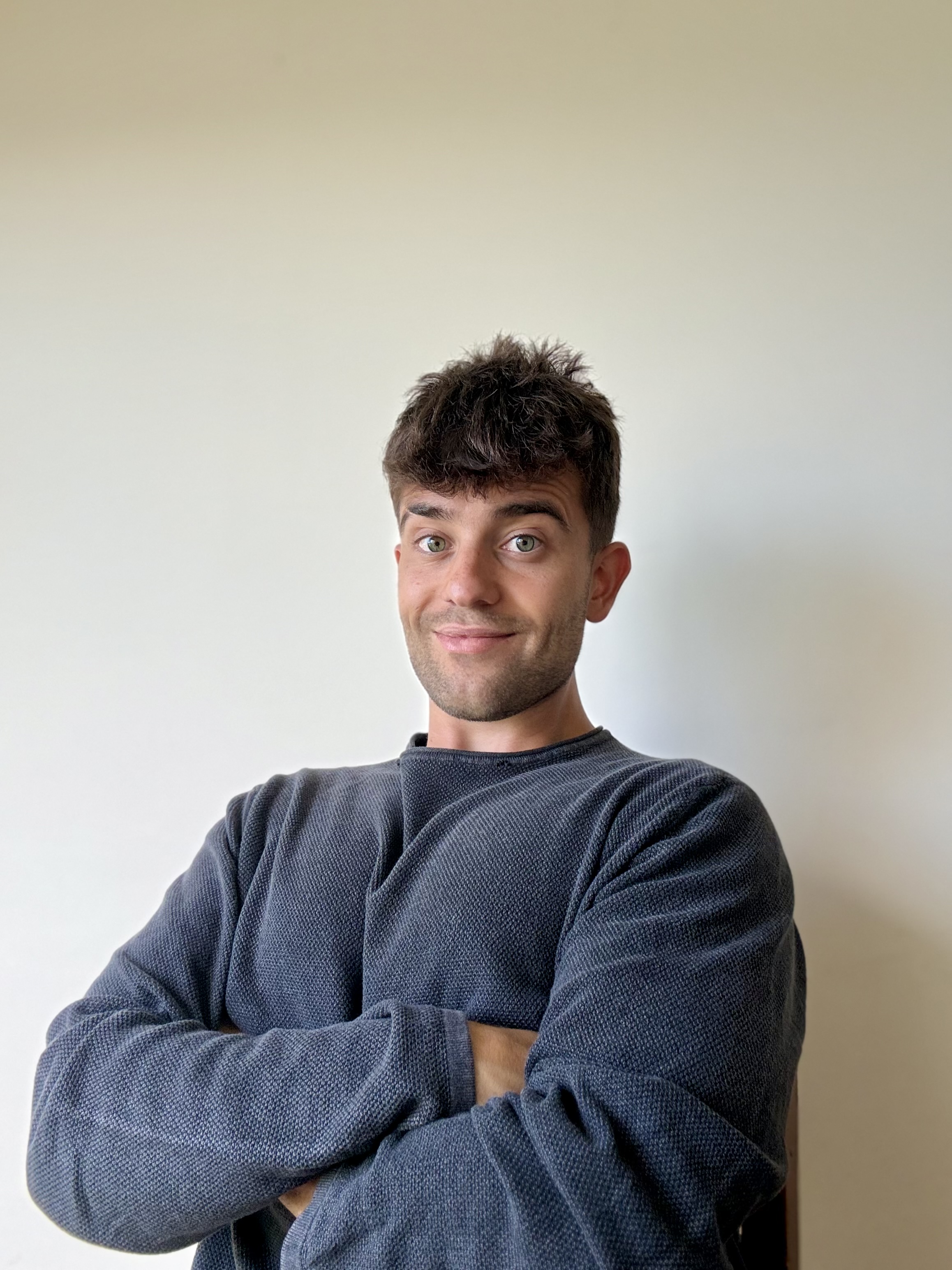
I'm Pablo — quant researcher, with a
BSc in Physics and an
MSc in Nuclear and Particle Physics,
and time spent in both industry and research.
I now apply that same rigor to markets: from the physics formalism to pricing, stochastic
processes and the risk management you'll work through here. Over 80,000 people follow me
because I make hard things land — that's the whole skill.
"My real ability is communicating: making the complex simple, so you can understand it too."
Industry experience Quant researcher 80K+ following
§7 Students
E
@estebandidote
Instagram · PhD in Accounting, Chicago Booth
“I love the way you teach. I’m doing a PhD in Accounting at Chicago Booth, where I took Asset Pricing with Lars Peter Hansen and Stefan Nagel — these concepts you explain are exactly the ones you see in those advanced classes. You explain them in a very intuitive, clear way.”
N
Néstor Nieves
Instagram · @nestor_nieves_vic
“I built the Monte Carlo model for valuing a structured note. Your content helped me a lot.”
S
Sergio
Discord · student community
“Just finished the whole course. Incredible, Pablo — congratulations on being able to distill such complex things into such simple concepts. Really looking forward to the advanced course.”
●
Student
Direct message
“A 10/10 for the course. I’ve really liked the approach so far, and I’m sure it’ll give me ideas to apply in my own project.”
S
santi.fog
Discord · student community
“I wanted to share my progress. I’m on the maths refresher — I’m enjoying it a lot and learning a great deal, since I never had the chance to learn algebra before. Really informative.”
Written in Spanish and translated here — each quote links to the untouched original screenshot. More than 300 students in over 20 countries have taken the program.
Special launch offer — save $100
$297 USD$197USDOne-time payment · Lifetime access to all modules & code repos
Or split it into 4 payments with Klarna, PayPal or Apple Pay
✓Six weeks of recorded sessions — watch at your pace, forever.
✓Every Jupyter notebook used in the program, ready to run.
✓Downloadable PDFs and reference material.
✓Private Discord with a channel per module and direct support.
✓The capstone project — your own pricing engine or backtest.
✓Lifetime updates at no extra cost.
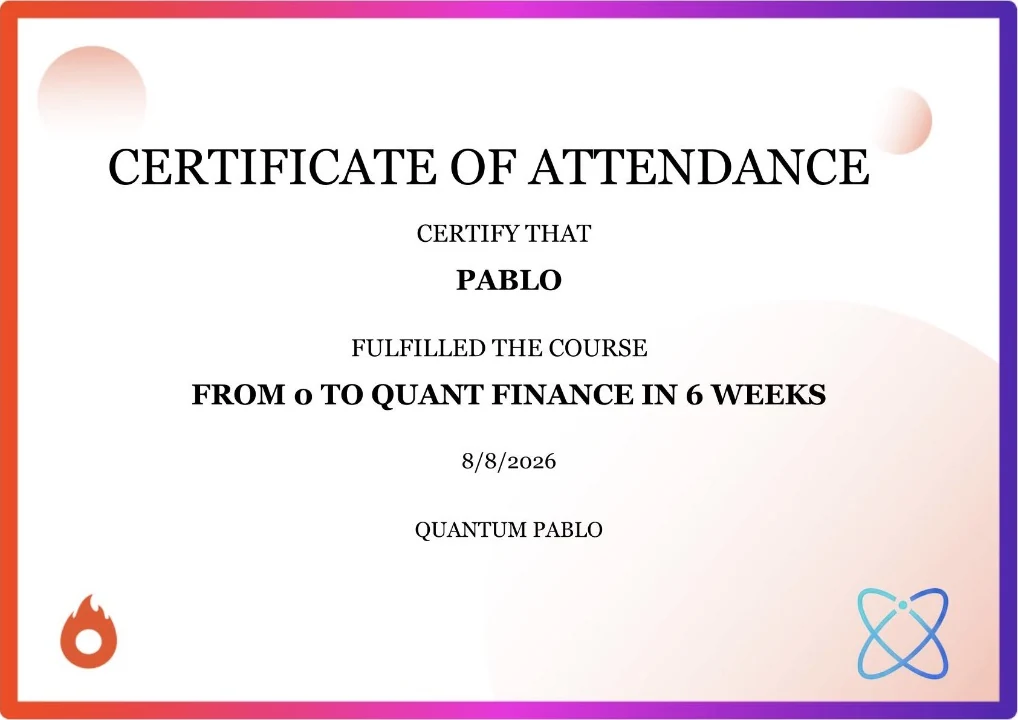
✓An official certificate of completion in your name, validated by Hotmart.
Official certificate, validated by Hotmart — which guarantees its authenticity.
Questions
Before you enroll
What language is the program in?
English. The program was originally recorded in Spanish; the English version is AI-dubbed and subtitled, with the notebooks, slides and written material translated and reviewed. The math and the code are identical. Ask questions in English in the Discord — you'll get answers in English.
Do I need a finance background?
No. The program starts from zero. Week one sets up the environment and the math you need before anything advanced. If you already have the background, you'll simply move faster.
Do I need to know how to code?
No. Week one takes you from nothing to a working Python environment. Every notebook is provided, so you're always editing working code rather than staring at a blank file.
How much math do I need?
Calculus, linear algebra and some probability is enough to start, and there's a refresher built in. The whole philosophy is making what looks impossible accessible.
Is it live or self-paced?
Self-paced. Sessions were recorded live and are yours permanently, alongside the notebooks. Six weeks is the recommended rhythm — plenty of people take longer, and the material doesn't expire. The Discord is where live questions get answered.
How much is it and how do I pay?
$197, one time, lifetime access including all future updates. Checkout is handled by Hotmart, which accepts cards and offers installment options. Access is immediate once payment clears.
Will this get me a quant job?
Nobody can promise you a job, and I won't. What this gives you is the foundation quant interviews are built on — pricing, simulation and risk — plus a project you wrote yourself and can explain line by line. That's what actually moves a conversation forward.
Is this investment advice?
No. This is an educational program about quantitative methods. No signals, no recommendations, no portfolio advice — you learn to build and interpret the models yourself.
Do I get a certificate?
Yes. Once you finish the program you get an official certificate of completion in your name, validated by Hotmart, which guarantees its authenticity. You download it from the platform and can add it to your LinkedIn or résumé. That said, what really opens doors is the capstone project you build yourself — the certificate supports it, the code proves it.
What if it's not for me?
You have 14 days for a full refund, no questions asked. You can also look at the free content on YouTube and Instagram first, or join the Discord — free and open to anyone.